ADAPT Research Team
The Northeast sits at one of Earth’s most remarkable biodiversity crossroads. Here at the confluence of three biogeographical realms, species have evolved in isolation across a landscape that ranges from 8,586-meter peaks to monsoon-drenched valleys receiving over 11 meters of rain annually. What makes this region exceptional isn’t just the number of species rather what they represent for regional stability in an era of climate volatility and deepening ecological uncertainty. This essay examines Northeast India’s biodiversity through four interconnected lenses – how species diversity buffers climate shocks, sustains livelihoods, upholds indigenous knowledge systems and supports the natural infrastructure that holds the region together. On International Biodiversity Day, we don’t just celebrate what exists, we reckon with what we’ll lose if it disappears!
Part One: Where Three Worlds Meet
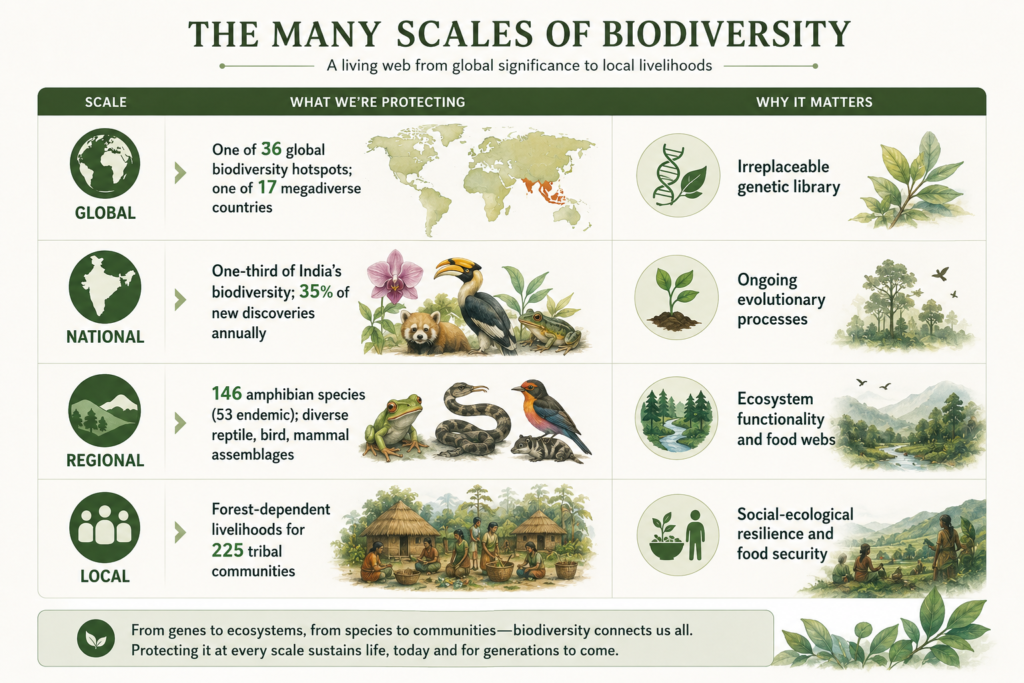
Northeast India doesn’t follow the usual rules of Indian biogeography. The region spans eight states i.e. Arunachal Pradesh, Assam, Meghalaya, Manipur, Mizoram, Nagaland, Sikkim and Tripura and occupies just 7.98% of the country’s land area. Yet it holds more than one-third of India’s total biodiversity. This isn’t proportional. It’s unprecedented.
The reason lies in geography. The Northeast sits where the Indo-Malayan, Indo-Chinese, and Indian biogeographical realms converge. This overlap created a natural laboratory where species from different origins collided, mixed and adapted resulting in a region where you can travel from tropical forest to cold alpine meadow in a matter of hours and each zone harbores distinct species found nowhere else on Earth.
The numbers alone don’t capture what this means. The region contains 146 amphibian species and 53 of them endemic, found only here. It’s one of the world’s richest bird areas, an important migratory route documented with over 2,400 bird species occurrence records stretching back to 1909. For reptiles and freshwater turtles, the Indo-Burma region extending into Northeast India shows exceptional endemism, with many species critically threatened and others barely known to science.
And we’re still discovering new species. In 2024 alone, Northeast India contributed over 35% of India’s new species discoveries including 683 faunal and 433 floral taxa added to the scientific record in a single year. Arunachal Pradesh led the findings, a state that’s only beginning to be thoroughly surveyed.
Part Two: When Climate Breaks Livelihoods
The Northeast is experiencing a particular kind of crisis that doesn’t make international headlines but reshapes lives daily. It’s not one problem rather three converging at once – biodiversity loss, climate volatility and livelihood collapse all feeding into each other. Tribal populations in the region face altered monsoon patterns, deforestation, crop failures, food insecurity and health impacts from climate change. But what often gets missed is that these aren’t abstract problems. When monsoon timing shifts even by weeks, farmers plant at the wrong time. Herders in Sikkim like the Dokpa who depended on seasonal pastoralism for generations have abandoned that livelihood entirely. Sheep rearing has stopped in valleys like Lhona and herders now work through government employment schemes instead. This shift represents not just economic change but the collapse of a cultural identity tied to the land. This is where biodiversity enters as critical infrastructure and not as an aesthetically pleasing element.
Biodiversity as Shock Absorber
When one crop fails, others remain. When a single livelihood disappears, alternatives exist. When a forest burns, wetlands still hold water. Biodiversity functions as a buffer in three overlapping ways –
- Ecological buffering – Traditional agroecosystems in the Northeast like mixed cropping, agroforestry, intercropping with wild plants represent centuries of climate adaptation strategy encoded in practice. These aren’t primitive systems but sophisticated responses to a region prone to monsoon shifts and land instability
- Economic diversification – Over 100,000 fishermen depend on Northeast wetlands for livelihoods. These same wetlands exist independently of land-based agriculture. They absorb floodwater, recharge aquifers, store carbon and support fish populations that feed families. When farming fails, fishing remains.
- Carbon infrastructure – Despite representing 7.98% of India’s land, the Northeast holds one-fourth of the country’s forest cover. These forests store terrestrial carbon at massive scale. Lose them and you lose not just biodiversity but also the climate mitigation capacity that took centuries to accumulate.
Today, there’s something confusing happening in the Northeast that deserves attention. Forest cover has been increasing in recent years due to plantation and community development schemes yet biodiversity continues to decline. Not all forests are equally biodiverse.
Forest coverage by state tells part of this story:
| State | Total Area (sq.km) | Forest (sq.km) | Coverage % |
| Arunachal Pradesh | 83,743 | 68,019 | 81.22% |
| Mizoram | 21,081 | 18,430 | 87.42% |
| Meghalaya | 22,429 | 16,839 | 75.08% |
| Nagaland | 16,579 | 13,609 | 82.09% |
A monoculture plantation of a single species looks green from a satellite but doesn’t store the same genetic diversity. It doesn’t support the same food webs. It doesn’t provide the same range of livelihood options and the micro-climatic conditions for diversity to exist and resilience to be.This matters because increasing forest area without increasing forest quality doesn’t solve the resilience problem. Communities need diverse forests that produce diverse products. Ecosystems need diverse species that create diverse functions. Planting trees is important but which trees, planted matters enormously.
Part Three: The Inventory
An inventory reveals biodiversity isn’t abstract. It’s tangible natural capital – something that can be measured and protected. India contains roughly 7-8% of all recorded global species. Over 45,000 plant species and 91,000 animal species and the Northeast’s contribution is disproportionate.
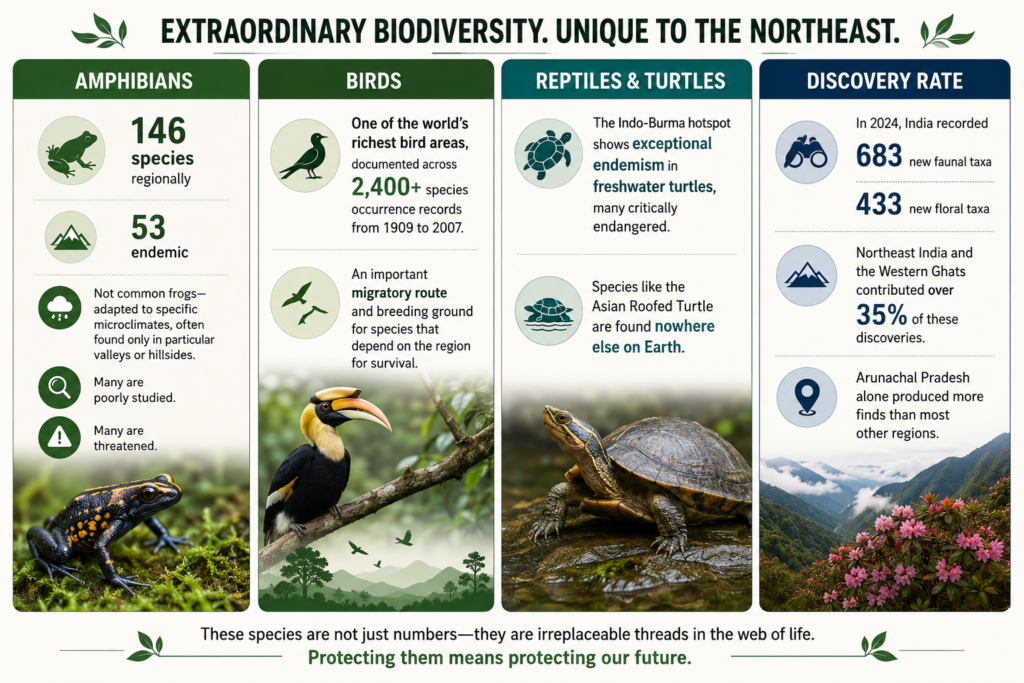
This high discovery rate is significant. It means the region isn’t fully catalogued. It means species we haven’t yet named are disappearing before we know they exist.
The Livelihood Assets
Biodiversity isn’t conservation for its own sake in the Northeast. It’s the foundation of economic survival for hundreds of thousands of people. The region is home to approximately 225 tribes, nearly half of India’s 450 tribal communities. These communities’ cultures, customs and land management practices are inseparable from biodiversity conservation. They don’t just live in forests; they’re part of how forests function. In study areas surveyed, 89.9% of populations were tribal, exhibiting direct and indirect dependence on mixed forest resources for subsistence and livelihood. They harvest timber, collect non-timber forest products, practice hunting and gathering, and maintain agricultural systems intertwoven with forest management. The region also contains approximately 133,969 hectares of wetlands supporting over 100,000 fishermen. These aren’t marginal populations. They’re substantial economic communities whose existence depends on ecosystem health.
The Knowledge Assets
Indigenous knowledge systems are themselves critical assets often overlooked in technical discussions.
Traditional farming systems across the Northeast employ mixed cropping, agroforestry, intercropping, flexible weeding strategies, and wild plant gathering. These aren’t subsistence practices that will be outgrown. They’re adaptation strategies that work. Indigenous communities observe environmental changes with remarkable precision and anticipate climate shifts based on accumulated generations of observation.
This knowledge is already being lost. As younger generations leave agriculture or adopt monoculture practices, traditional systems disappear. When those systems vanish, so does the accumulated wisdom about which crops thrive in variable rainfall, which varieties tolerate flooding, which intercropping patterns sustain soil health.
Sikkim offers one model of preservation: the state adopted an organic farming mission that scales traditional practices while supporting farmer livelihoods. It’s not perfect, but it shows that indigenous knowledge can be institutionalized rather than abandoned.
What Breaking Biodiversity Means
Biodiversity loss in the Northeast doesn’t unfold as a single failure. It triggers simultaneous breakdowns across interconnected systems.
Lose the fisheries and you don’t just lose source of food but you lose the economic independence of 100,000 people. Forest product markets that currently sustain communities disappear. Agricultural systems built on crop diversity contract to monoculture. What remains are narrower livelihood options often dependent on external employment schemes that community members never chose.
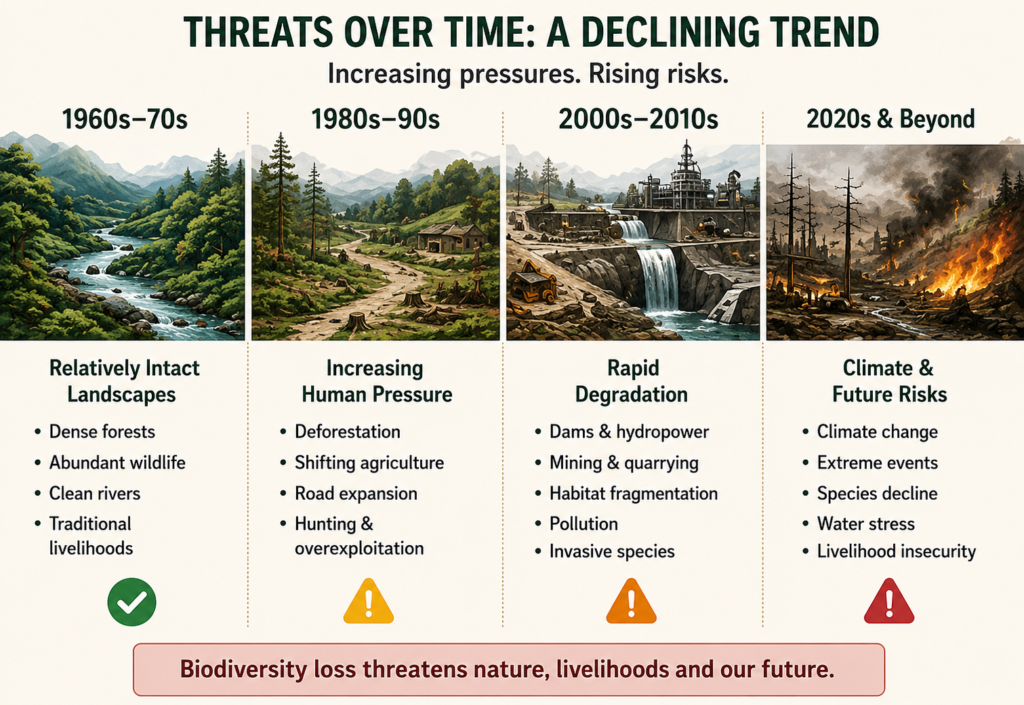
The climate consequences compound. Carbon storage capacity that took centuries to accumulate vanishes within years. Water regulation becomes erratic as the monsoon’s moisture gets trapped less effectively, groundwater recharges less reliably. Temperature swings intensify. The region that already experiences both extreme flooding and drought becomes more susceptible to both, simultaneously.
But the deepest damage is cultural. Tribal land management practices aren’t quaint traditions awaiting extinction. They’re functioning knowledge systems that have sustained communities through climate variability for generations. When those practices disappear they’re typically replaced by external technical systems designed for contexts entirely unlike the Northeast. Younger generations find themselves caught between two worlds – traditional livelihoods no longer viable and modern alternatives inaccessible or incompatible with regional conditions.
And underneath everything, evolution itself slows. Speciation processes arrest. Genetic diversity narrows. The region loses its capacity to generate new species adapted to future conditions it will inevitably face.
These aren’t separate problems. They’re aspects of a single integrated crisis. Biodiversity loss doesn’t neatly compartmentalize, it cascades through economic, climate, social and evolutionary systems simultaneously.
Reckoning, Not Celebration
International Biodiversity Day often leans toward celebration. The Northeast’s situation demands reckoning instead. What’s happening here is simultaneously a development crisis, a livelihood crisis, a climate crisis, and a cultural crisis. Treating them as separable is analytically false and strategically naive. No amount of livelihood intervention fixes a climate problem. No climate mitigation strategy rescues communities losing access to traditional knowledge. No economic development works on a collapsing ecological base.
The path forward isn’t incremental improvement. It requires fundamental reorientation.
The Foundation
Biodiversity isn’t one factor among many in the Northeast’s future. It’s foundational. You can build economic development on unsustainable biodiversity extraction but only for a while. You can develop infrastructure on degraded ecosystems until they fail. But you cannot build durable regional resilience on anything other than a biodiverse base. Attempt it and you’re building on sand. The structure will hold until the first significant shock which in the a fragile region like the Northeast won’t take long.
The choice isn’t between biodiversity and development. It’s whether development happens in service to regional resilience or hastens its collapse.
—
This essay draws on research from the Zoological Survey of India, Botanical Survey of India, Forest Survey of India, state biodiversity boards, and peer-reviewed studies on Northeast India’s ecology, climate adaptation, and indigenous knowledge systems.
Suggested Citation: ADAPT. “The Buffer That Holds: How Northeast India’s Biodiversity Sustains Regional Resilience.” Alliance for Development & Progressive Transformation. May 2026.